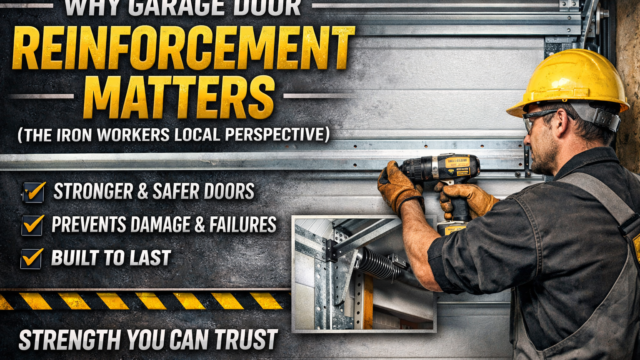
Why Garage Door Reinforcement Matters (The Iron Workers Local Perspective)
When most homeowners think about garage doors, they think about convenience—getting in and out quickly, keeping vehicles secure, and protecting storage space. But from an Iron Workers Local perspective, a garage door isn’t just a moving panel on tracks… it’s a large structural system under constant tension, weight, vibration, and pressure.
That’s why garage door reinforcement matters more than people realize.
Whether you own a residential home or manage a commercial property, reinforcement is the difference between a garage door that simply “works for now” and a garage door that stays strong, balanced, and secure for years.
Garage Doors Are Bigger, Heavier, and Under More Stress Than You Think
Iron workers understand one thing better than anyone: steel systems fail when stress points aren’t supported properly.
A garage door might look lightweight, but in reality, it can weigh anywhere from 130 to 400+ pounds, depending on:
-
Door material (steel, aluminum, wood, composite)
-
Door size (single vs. double garage)
-
Insulation layers
-
Windows and added hardware
-
Wind load requirements in certain areas
Every time the garage door opens and closes, it creates repeated force on:
✅ Tracks
✅ Hinges
✅ Rollers
✅ Brackets
✅ Center bearing plates
✅ Torsion springs and cables
✅ The entire door panel structure
Without reinforcement, those points can bend, loosen, or crack—especially over time.

What “Reinforcement” Really Means in Garage Door Terms
In ironwork, reinforcement means supporting a structure where stress concentrates, so it stays aligned, stable, and safe.
In garage doors, reinforcement can include:
✅ Struts (Horizontal Reinforcement Bars)
These are metal support bars installed across the door sections.
They help prevent:
-
Door panel bending
-
“bowing” in the center
-
shaking during movement
-
weak top section failure from opener pressure
✅ Bracket Reinforcement Plates
This strengthens areas around:
-
opener arm attachment point
-
hinges and roller brackets
-
bottom fixtures where lift cables connect
✅ Heavy-Duty Tracks and Hardware
Commercial or oversized doors often require:
-
thicker gauge tracks
-
stronger bearings
-
upgraded rollers
-
reinforced jamb brackets
Because when a door is heavy, standard hardware is not enough.
✅ Wind Load Reinforcement
This is especially important in high-wind regions.
Wind load reinforcement can include:
-
stronger vertical track support
-
additional bracing
-
heavier struts
-
reinforced end stiles
Wind doesn’t have to “tear the door off” to do damage—sometimes it just pushes the door enough to cause misalignment and expensive breakdowns later.
The Real Risks of a Weak Garage Door Structure
From the outside, a garage door might still “move” even if reinforcement is missing. But iron workers know: a system can function while quietly getting weaker.
Here are the most common reinforcement-related issues we see:
1. Door Panels Start Bowing or Cracking
This is extremely common on:
-
long double-car doors
-
older doors
-
doors with windows
-
doors with thin steel skins
Once a section bows, it throws off the balance and causes uneven force during operation.
2. The Opener Begins Straining
Many homeowners replace the opener thinking the motor is bad.
But the truth is:
The door is the problem, not the opener.
A weak door structure creates:
-
jerky movement
-
extra resistance
-
vibration
-
early gear wear
Reinforcement takes stress off the opener and extends its life.
3. Tracks and Rollers Wear Faster
When the door flexes, it stops traveling smoothly.
That means:
-
rollers grind instead of roll
-
tracks develop pressure points
-
hinges loosen
And the door can come off-track in the worst cases.
4. Safety Becomes a Serious Issue
Iron workers treat safety as non-negotiable.
A poorly reinforced garage door can increase the risk of:
⚠️ cables snapping under uneven load
⚠️ sections collapsing
⚠️ brackets ripping away from the door
⚠️ door slamming shut unexpectedly
Reinforcement Is Not Just “Extra”… It’s Structural Protection
Iron Workers Local crews understand that every structure needs:
-
stable anchoring
-
reinforced joints
-
stress distribution
-
alignment under load
A garage door works the exact same way.
Reinforcement provides:
✅ Better stability during open/close cycles
✅ Less vibration and shaking
✅ Improved door balance
✅ Longer hardware life
✅ Stronger security and resistance to impact
✅ Reduced repair costs over time
When reinforcement is done correctly, the entire system operates smoother, quieter, and more predictably.
When Should You Reinforce Your Garage Door?
Here are situations where reinforcement is strongly recommended:
✅ If Your Door Is 16 Feet Wide (Double Door)
Wide doors are far more likely to flex without struts.
✅ If You Have an Insulated Door
Insulated doors can be heavier than expected.
✅ If You Have Windows on the Top Panel
That section becomes a weak point where bending happens most often.
✅ If Your Door Is Shaking or Vibrating
That’s a sign of structural instability, not just “loose hardware.”
✅ If You’re Upgrading to a New Garage Door Opener
A strong opener on a weak door often causes the top panel to fail faster.
The Iron Workers Local Mindset: Build It Like It Has to Last
Iron workers don’t build temporary solutions.
They build:
-
frameworks that hold load
-
systems that survive stress
-
structures that stay aligned over time
That same thinking applies to garage doors.
Reinforcement isn’t about overbuilding—it’s about building correctly.
Because when a garage door is reinforced properly, it becomes:
✅ safer
✅ stronger
✅ more secure
✅ more reliable
And most importantly—it performs the way it should.
Reinforcement Saves You Repairs, Time, and Risk
If you want your garage door to operate smoothly, last longer, and stay safe for your family or customers, reinforcement is one of the smartest upgrades you can make.
Need Your Garage Door Reinforced the Right Way?
If your garage door is shaking, bowing, struggling to open, or you’re planning a new opener installation, it may be time for a reinforcement check.
A garage door professional inspection can confirm whether you need:
-
struts
-
reinforced brackets
-
upgraded tracks
-
wind-load support
-
balance and tension adjustments
A reinforced garage door isn’t just stronger—it’s safer and built to last.